ECHO-GEmbodied Co-speech Humanoid mOtion Generation
Full-body robot motion from speech audio and timed transcripts.
Main video
Real-robot demonstrations
Conditioning comparison
Shared audio
Audio-only
Audio + TextOurs
Text-only
Quantitative results
BEAT2 speaker-held-out evaluation
Bold: bestUnderline: second-bestLower is betterHigher is better
Table IGeneration pipelines
Scroll table →
| Method | Co-Speech Motion Characteristics | Robot Motion Quality | Efficiency | ||||||
|---|---|---|---|---|---|---|---|---|---|
| FGD | ΔDiv | MM | ΔBA | ΔJerk | Foot Err.(m) | C-Slide(m/s) | E2E Time(ms/frame) | Peak RAM Δ(MB) | |
| EMAGE+GMR | 4.976 | 0.749 | 0 | 0.172 | 26.951 | 0.013 | 0.163 | 21.3 | 2661 |
| GestureLSM+GMR | 5.008 | 0.561 | 1.016 | 0.158 | 24.444 | 0.010 | 0.169 | 20.5 | 3804 |
| Human-Retargeted | 4.725 | 0.408 | 1.498 | 0.161 | 8.001 | 0.003 | 0.050 | 6.56 | 18714 |
| Ours | 2.278 | 0.320 | 1.786 | 0.063 | 9.039 | 0.008 | 0.052 | 5.96 | 18542 |
ΔDiv, ΔBA and ΔJerk are absolute deviations from matched ground-truth statistics over each method’s evaluated motion range.
Table IIConditioning modalities
Scroll table →
| Method | FGD | ΔDiv | MM | ΔBA | ΔJerk | Foot Err.(m) | C-Slide(m/s) |
|---|---|---|---|---|---|---|---|
| Audio-only | 2.360 | 0.360 | 1.702 | 0.081 | 4.497 | 0.008 | 0.038 |
| Text-only | 2.436 | 0.429 | 1.681 | 0.113 | 5.940 | 0.009 | 0.049 |
| Ours | 2.278 | 0.320 | 1.786 | 0.063 | 9.039 | 0.008 | 0.052 |
ΔDiv, ΔBA and ΔJerk use shared ground-truth statistics. Ties at the displayed precision receive identical highlighting.
Architecture
Abstract
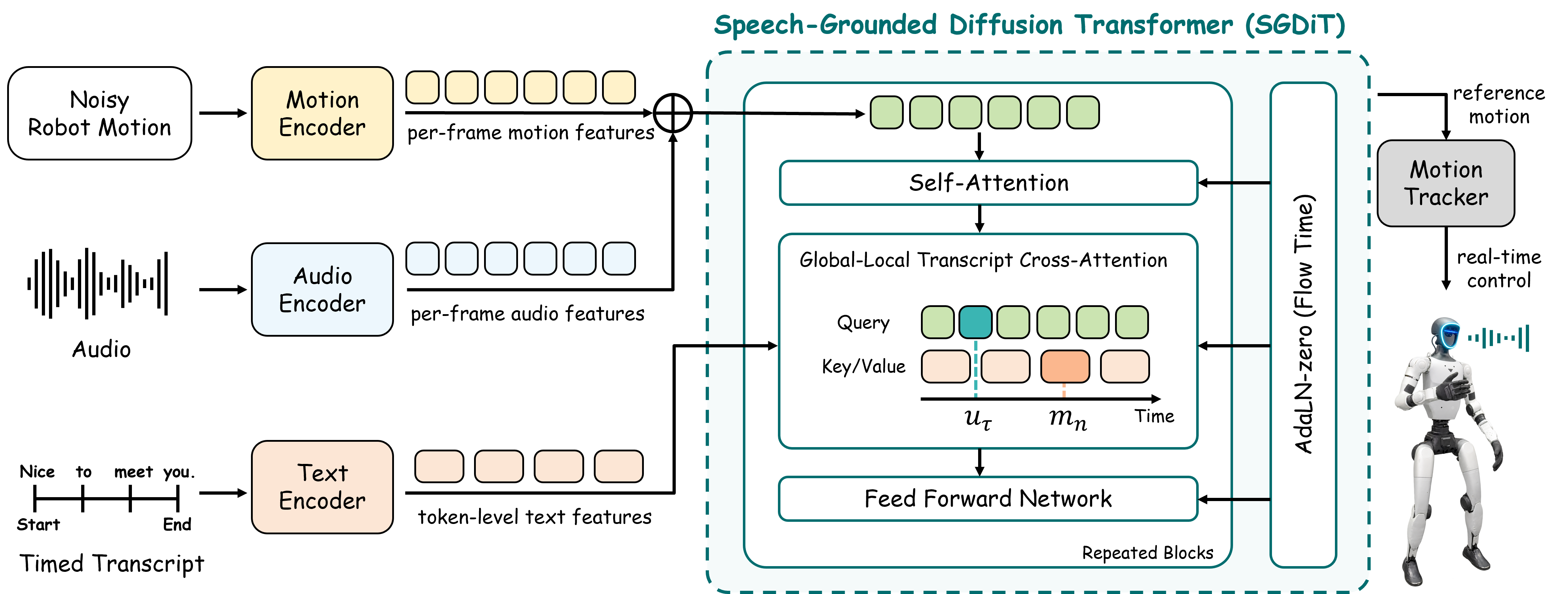
Generating full-body co-speech motion for humanoid robots requires coordinating speech prosody, linguistic content, and embodiment-specific motion. To this end, we present ECHO-G, a framework that jointly conditions full-body robot-motion generation on speech audio and timed transcripts. Its Speech-Grounded Diffusion Transformer (SGDiT) integrates frame-aligned acoustic features into the motion stream and retrieves token-level linguistic context through global and temporally biased cross-attention. Trained with rectified flow matching, SGDiT models the one-to-many relationship between utterances and accompanying gestures directly in robot space. To support training and evaluation, we introduce a BEAT2-derived dataset pairing audio and timed transcripts with robot motion, together with a benchmark covering co-speech characteristics, robot-motion quality, and runtime efficiency. Comparative evaluation supports direct robot-space generation over the evaluated human-motion generation and retargeting pipelines, while modality ablations highlight the benefits of joint audio–text conditioning. We further demonstrate deployment on a physical humanoid robot. A complementary video-rating user study also favors joint conditioning over the compared configurations.